Background for the initiative
Summary
Technologies play a fundamental role in shaping society and people’s lives, creating both opportunities and barriers for wellbeing. At DTU, developing research outcomes and solutions that are relevant and responsive to societal and human needs is integral to research excellence.
The intensification of the global technology race and increasing geopolitical pressures on Europe reinforce the need to develop technologies both rapidly and responsibly, with society and people at the core. Against this backdrop, DTU’s foundational commitment to benefiting society remains a relevant and important guiding principle for developing research and technologies that are innovative and responsible toward society and humans.
This initiative directly supports DTU’s strategic focus area on democratic responsibility by strengthening human-centered approaches and consideration on representation, inclusion, and societal relevance across DTU’s research activities. Through learning materials, tools and facilitated workshops and counselling, it supports DTU’s researchers in integrating societal, democratic and ethical considerations into the research process, from the early stages of idea development to dissemination and implementation.
Background
Over recent years, Europe has experienced profound political and societal transformation, reshaping the European research landscape and technological development. This produces a need for revisiting and developing research practices and culture at the institutional level. Against this backdrop, DTU has launched this initiative aimed at advancing democracy, ethics and societal responsibility in research across the university.
Amid the geopolitical turmoil Europe is navigating, the need to strengthen its competitiveness and innovation capacity has become increasingly urgent. The Draghi Report from 20241 highlights the critical importance of closing the innovation gap with China and the United States, particularly in relation to technologies such as quantum technology, artificial intelligence, defence technologies, and green technologies, if social welfare on the continent is to be sustained.
At the same time, the unprecedented pace with which technological development is accelerating risks pushing human, ethical and social dimensions into the background. At a societal level, we also see public trust in science and technology dropping, partly as a result of how technological advances are seen as leaving underrepresented groups in society behind and hereby exacerbating social disparities and marginalisation.
These challenges are acknowledged at EU level, and among research funding agencies, there is an increasing push to embed ethical, social and democratic considerations into research. Funding frameworks such as the Horizon Europe require attention to gender, diversity, and their intersections in research and the European Digital Humanism Initiative promotes a human-centric approach to digital transformation.2 These requirements prompt a need for research institutions and projects to consider relevance, applicability, accessibility and inclusivity throughout the research practice, in the research design and content.
The internal pressures on researchers and research environments driven by hypercompetition, narrow evaluation frameworks, and persistent inequalities in academia have similarly created a call for systemic change. In response, the Coalition for Advancing Research Assessment (CoARA), has been established as a collaborative effort to reform how research quality and impact are evaluated.3 As a member of CoARA, DTU is committed to fostering a more inclusive, impact-oriented, and future-proof research culture, allowing for impact in many ways.4 This involves recognising and rewarding research excellence in broader terms than traditional metrics, ensuring that diverse contributions to science, society, and innovation are valued alongside quantitative indicators.
Within this context, DTU’s new strategy “Til gavn for samfundet siden 1829” (“For the benefit of society since 1829”) reinforces the university’s ambition to lead responsible research and innovation, aiming to continuously benefit society in meaningful ways. As one of Europe’s foremost technical universities, DTU is committed to driving technological development that is firmly grounded in ethical, societal and human responsibility, reflecting the fundamental European democratic values and principles.
This initiative supports this mission. To ensure the legitimacy of research and innovation and to make new knowledge and technologies trustworthy, democratic and available to society at large, it is imperative to address diversity, social sustainability, and responsibility toward society and citizens from the outset and throughout the research process. This is at the centre of this initiative that aims to bring attention to and building awareness of democracy, equity and accessibility. This strategic priority is operationalised through collaborations, active engagement, learning materials, workshops, and tools designed to strengthen representation and societal impact in DTU’s research.
Purpose
The initiative’s overall purpose is to strengthen awareness and build competence in integrating democratic, societal and human ethical aspects into the research practices across DTU. Specifically, the project aims to support researchers in applying inclusive, societal and human-centred approaches through guidance, learning materials, facilitated workshops and reflection exercises that center their own research areas.
Organisation
The initiative is framed as a two-year strategic action with a defined set of deliverables, while long-term goals of organisational development and learning are achieved through implementation extending beyond this period.
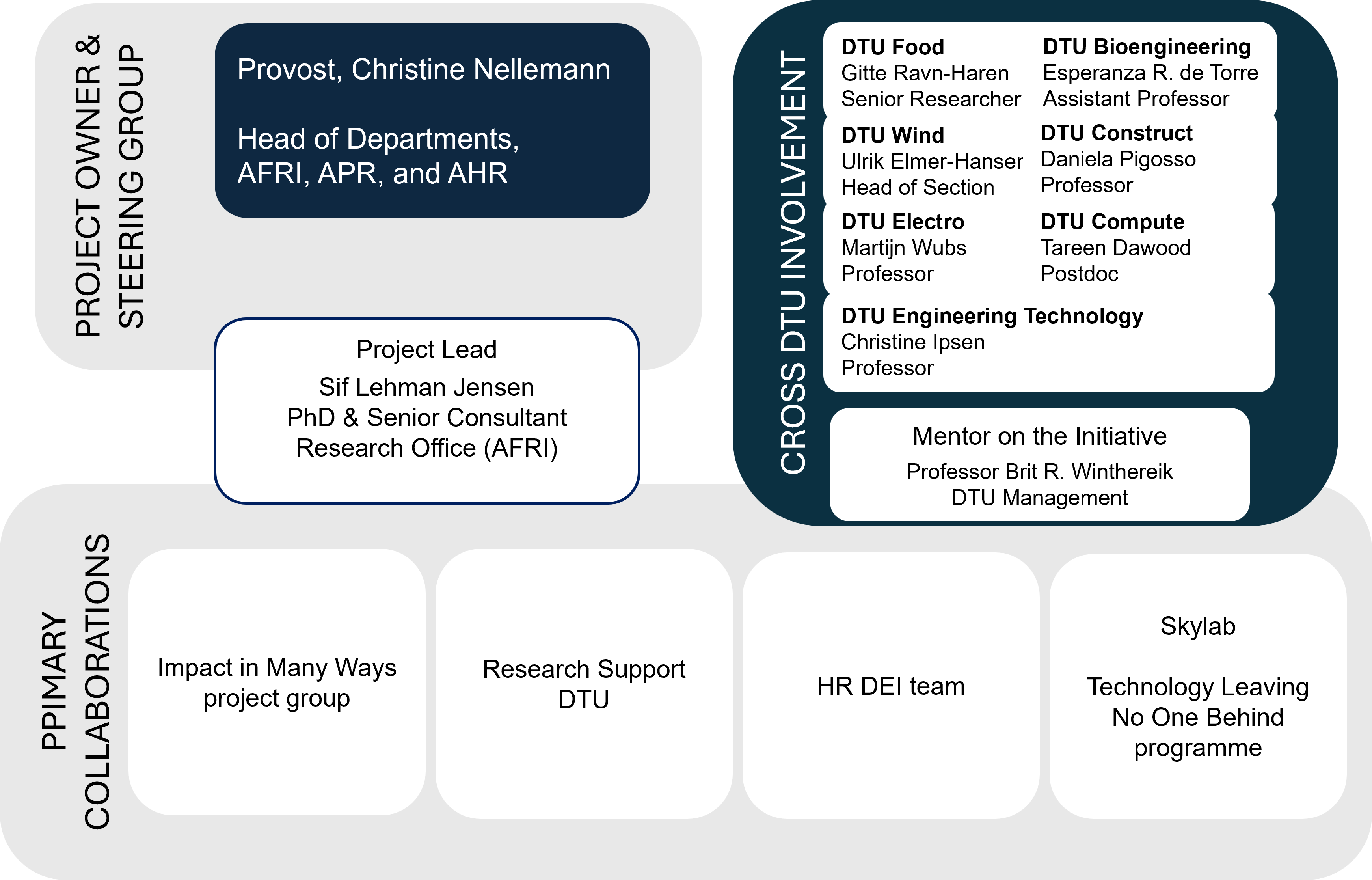
The initiative is anchored in the Research Office, the department of Research, Advice and Innovation and forms part of the organisational framework of the ‘Impact in Many Ways CoARA’ programme that outlines a series of initiatives addressing DTU’s commitment to CoARA. Alignment and coordination with DTU’s other activities related to the Gender Equality Plan (GEP) and diversity, equity and inclusion is ensured through ongoing collaboration with HR’s DEI team. In addition, collaborations with other DTU programmes that share the agenda of advancing democracy, ethics, social responsibility and sustainability are actively pursued.
Project owner and steering group
The project is owned by DTU’s Provost, who oversees that the project’s objectives align with DTU’s overall ambitions and strategic priorities. The steering group consists of the directors of three central administrative departments (the Department for Advice, Research and Innovation, the HR Department, and The Policy and Relations Department), who ensure alignment between this initiative and the overall strategy and objectives of the CoARA programme.
The initiative is anchored in the Research Office (AFRI) and led by Sif Lehman Jensen, who is responsible for the development and progress of the project deliverables, and ensuring collaboration with management and stakeholders.
To ensure the relevance and usability of the project across DTU’s research fields, a reference group has been established to provide input and feedback on the project’s scope, development and materials.
The reference group broadly represents different research areas and departments at DTU, and consists of:
DTU Food, senior researcher, Gitte Ravn-Haren
DTU Construct, professor, Daniela Pigosso
DTU Wind (Risø Campus), head of section, Ulrik Elmer-Hansen
DTU Electro, professor, Martijn Wubs
DTU Compute, postdoc, Tareen Dawood
DTU Bioengineering, assistant professor, Esperanza Rivera de Torre
DTU Engineering Technology (Ballerup Campus), professor, Christine Ipsen
Professor Brit Winthereik, DTU Management, is mentoring the initiative. Further, a broader central anchoring and alignment is secured through collaboration with Research Support DTU as well as CoARA lead Stine Work Brodersen and the Impact in Many Ways project group.
1 https://commission.europa.eu/topics/competitiveness/draghi-report_en#paragraph_47059
2 https://cordis.europa.eu/project/id/101212890
https://horizoneuropencpportal.eu/sites/default/files/2022-04/gep-eligibility-criterion-in-he.pdf
3 https://www.coara.org/agreement/the-agreement-full-text/
4 https://www.dtu.dk/newsarchive/2025/12/paa-dtu-gaar-impact-og-excellence-haand-i-haand
Contact
Sif Lehman Jensen Office for Research, Advice and Innovation Mobile: +45 93511140 sleje@dtu.dk